Stage Three: When Life Begins To Hurt
When the Life You Expected Meets the Life You Are Living
I Am Still Here. I Am Alive. I Have the Power.
There comes a point in many lives when the story changes. Sometimes dramatically. Sometimes so quietly that nobody else notices. You are still going to work, answering calls, attending meetings, cooking dinner, caring for people, showing up at weddings, funerals and family gatherings. You are still smiling in photographs.
From the outside, life may look perfectly normal. But inside, something has shifted.
Life has begun to hurt.
Not everywhere. Not all the time. But enough for you to notice. And the strange thing about hurt is that it does not come from only one direction. It can come from the workplace you once loved. From the career you worked hard to build. From marriage, friendship, or family relationship. From your children. From illness; yours, your spouses, parents, children; all whom you have to take care of. There is a huge loss when an independent you has to rely on another person whether your spouse, partner, sibling, child, or parent. It does not come easily, and we do not take time to appreciate and accept this. From monetary loss. From an opportunity that passed you by and it may bring bitterness on the loss. Sometimes it comes from the words of people you never expected would wound you. How could she say that after the journey we have walked together, you ask yourself.
And sometimes there are no villains at all. Life simply did not turn out quite the way you thought it would.
But This Is Not How I Thought It Would Be
When we are young, we imagine the future in broad, beautiful strokes. We will study. Graduate. Find good jobs. Build careers. Fall in love. Marry, perhaps. Have children, perhaps. Build homes. Make friends. Travel. Succeed. Support our parents. Grow old surrounded by people we love.
We hardly ever anticipate life’s unwritten footnotes. The promotion that does not come.The job that disappears. The opportunity for which you were perfectly qualified that goes to somebody else. The successful business that suddenly begins to struggle. The partnership that does not work how you expected. The friendship that becomes strained. The child who causes you sleepless nights.
The relative who wounds you. The workplace that becomes toxic. The boss who humiliates rather than leads. The colleague you trusted who betrays you. The marriage that becomes distant and lonely. The sacrifice nobody remembers. The day you realize that being needed is not necessarily the same thing as being valued. Nobody puts those things on a vision board. Yet they, too, become part of life.
When the Professional Woman Begins to Hurt
We do not always talk enough about workplace hurt. We emphasize performance, productivity, leadership, resilience, and results, while urging people to remain emotionally intelligent, adaptable, and professional. Yet workplaces are human communities, and people can hurt one another.
After years of building a strong professional reputation, a woman may find herself working for a boss who repeatedly belittles her. The criticism shifts from her work to personal attacks. She is excluded from key discussions, receives essential information late or not at all, and learns that decisions about her work were made without her. Her ideas are dismissed in meetings, then praised when someone else repeats them. A trusted colleague quietly undermines her, while a direct report challenges her authority but appears cooperative in public.
Someone takes credit for work she did.
An important email mysteriously leaves her out.
In the virtual workplace, even something as simple as being sent the wrong meeting link or the wrong time can mean missing a critical meeting and discovering only afterwards that everybody else attended.
Once might be an error. Repeatedly, you begin to wonder. Am I imagining this? That question can be one of the most damaging effects of a toxic environment. You begin doubting not only other people, but yourself.
When the Place That Paid You Begins to Cost You
Workplace bullying does not always involve shouting. Sometimes it is humiliation disguised as feedback.
Control disguised as supervision. Isolation disguised as restructuring. Impossible deadlines followed by criticism when you fail to meet them. Information withheld and then questions asked about why you did not act. Constant moving of the goalposts. Favoritism, threats, gossip, and public embarrassment. A leader who creates fear and then calls the team “too sensitive.” And because you are a professional woman, perhaps a senior one, you tell yourself:
It is not that bad. I can handle this.
So, you keep showing up. You work harder. You document more. You try to repair relationships. You become even more professional. You regulate your emotions. You tell yourself not to react. But emotional intelligence was never intended to mean enduring abuse intelligently. At some point, managing yourself must also mean protecting yourself. Sometimes courage is staying and addressing what is wrong. Sometimes it is documenting the behaviour. Sometimes it is reporting the abuse through the appropriate channels. Sometimes it is seeking advice and support. Sometimes it is changing departments. Sometimes it is changing jobs. And sometimes the healthiest thing you can do is walk out. Knowing when to persevere and knowing when to leave are both forms of wisdom. Walking away does not always mean you failed. Sometimes it means you finally stopped volunteering yourself for mistreatment.
And Then There Is Job Loss
For some people, you do not even have the choice of walking away. The job walks away from them. At the workplace, this could be retrenchment, restructuring, and a contract that is not renewed. In business, it could be closure or a sudden economic downturn. You can lose much more than a salary when you lose a job. You may lose routine; for me, structure is a key thing, and I panic and lose traction when I find myself in territory that has no structure. At such times, I have two options: build the structure or build the structure. There is also the loss of status: colleagues who no longer call you because all you ever talked about was work, so now there is nothing to talk about. You lose confidence, self-esteem, financial independence and, sadly, a professional identity you have built and carried for decades.
For someone who has always introduced herself through what she does, the question “So, what do you do?” can suddenly become surprisingly painful. Where are you calling from?
As a consultant, I get tickled when I call a certain office, and they ask me, Salome from where? (I must admit I have toyed with the idea of responding, my house or Kenya!)
And then comes the practical reality.
Bills do not become sympathetic because you lost your job; children still need school fees, parents may still depend on you, mortgages and rent remain due. And plans have to change.
That can hurt.
When the Dream After University Does Not Arrive
Think of the young graduate. For years, the story was simple: Work hard. Go to university. Graduate. Get a good job. Build a life. Perhaps she imagined herself driving a car, living comfortably, progressing at work, and sending something home to her parents. Then she graduates. No job. Applications disappear into silence. Internships pay little or nothing. Friends appear to be progressing faster. Social media does not help, as all she sees are posts of her friends’ growth and celebration. Everybody else seems to be announcing a new job, new car, engagement, wedding, scholarship or trip. Meanwhile, she may not even have enough money for transport to another interview. The disappointment is not merely:
“I do not have a job.” It can become: “Was my life not supposed to have started by now?” That is the painful space between the life expected and the life being lived.
When Disappointment Arrives
Some disappointments are easy to name. You applied. You did not get it. You trusted. You were betrayed. You expected honesty. You discovered a lie. You gave. It was not reciprocated.
But some of life’s deepest disappointments are harder to explain because nothing obviously catastrophic happened. You simply begin noticing the gap between expectation and reality. You thought your contribution would be recognized. It was not. You thought certain friendships would last forever. They didn’t. You thought by this age you would have reached the C-Suite, retired comfortably, entered certain circles or attained a particular level of financial security.
You have not. And milestones can become cruel when we turn them into deadlines for our lives.
“By this age, I should have………………………………………………………………….”
Should have what? Who wrote the timetable?
When Parenting Does Not Become Easier
We often imagine that parenting becomes easier when children become adults. After all, the school fees are over; they have graduated and have jobs. Surely now you can relax. A friend recently remarked that at this stage of life she had expected her children to be sending her money and gifts. Not that she needs it, but just an assumed gesture.
“Good luck!” I told her.
For many parents, the reverse is happening. Not because we raised ungrateful children, but because they are struggling, as most opted to be self-employed, hustle, and ‘work for myself’. Unlike we who were employed and employers covered our medical insurance, housing, school fees, life insurance, cars and car allowances, mortgages, the works. No wonder we were imprisoned for long durations. Today, adult children may still need help with rent, education, businesses, fees for their children, or simply establishing themselves. We call it “setting them up.” How much setting up is enough is a topic for another conversation! But there are more painful situations.
When Parent–Child Relationships Break Down
Relationships between parents and adult children can deteriorate painfully. Harsh words may be exchanged, and some adult children may cut off contact, sometimes describing their parents as toxic. Grandchildren can become caught in the conflict, while parents may continue loving a child who no longer wants a relationship with them.
Where the Hurt Can Begin
- Parents may have hurt their children, withdrawn support, or cut them off.
- Emotional disconnection may happen intentionally or unintentionally.
- Some parents have never expressed love openly, leaving their children with a deep longing that can become grief when it remains unmet.
These stories are now so common that coaches and other experts increasingly address bruised parent–child relationships on social media.
There may be legitimate histories, wounds, and perspectives on both sides that outsiders do not know; sometimes they take sides and positions that add pain to an already open wound.
But whatever the history, estrangement can hurt deeply.
A parent may disagree with a child’s choices, behaviour, or account of the past and still love that child. Sometimes love continues even when relationships have become difficult. The sad part is the grief these children face when such a parent passes away before reconciliation. These children are inconsolable, to the shock of close family members who witnessed the abuse meted to the deceased parent.
Yet it is not all doom and gloom. Many parent–child relationships have joyful seasons marked by mutual celebration, birthday cakes and flowers, caring phone calls, and regular visits. If your adult children call, visit, welcome you into their homes, remember you, or occasionally send even a small gift, cherish those gestures rather than taking them for granted.
“How Are You, Really?”
We ask each other, “How are you?” automatically. That is an English sentence, not a greeting, and the response to it is another English sentence or word. “Fine.” “I’m okay.” “Good.”
Sometimes we do not even wait for the response as we quickly move on to the next sentence. A psychologist friend, Dr. Flo, likes to add one word: really. “How are you really?” That one word changes the question enough to make you pause and think before you respond. Really. Not what did you achieve today? Not what needs to be done next? Not how is everybody else?
How are YOU, really?
Perhaps we should ask ourselves that more often.
A book club I am in is currently reading a book, Tuesdays with Morrie, and one lesson we agreed on is the importance of human connection and taking time to accept praise and appreciation. When told you have done something really well, just say, ” Thank you. Do not qualify or explain how you did it; just sit with that praise and accept it. Thank you!
Women have the habit of minimizing their achievements; Oh, it was nothing; anyone would have done the same thing. We are not talking about anyone and anything; we are talking about YOU! So, sit back and enjoy the praise. Not being arrogant or boastful, just reflecting what you have actually done, being appreciated, and realizing it was no mean achievement.
The Strong Woman Has a Problem
This brings me back to something from Stage Two, and to some of the comments that conversation generated. We talked about carrying, being capable, dependable, and adaptable. The woman who gets things done. These are wonderful qualities. Until everybody, including you, begins believing that because you can carry something, you should.
So you carry, and carry, and carry. Then one day, something that once seemed manageable becomes unbearably heavy. And you ask: What is wrong with me? I have handled worse than this.
Perhaps nothing is wrong. Perhaps you have simply been carrying for too long.
Even strength has limits.
When Being Taken for Granted Creeps In.
Being taken for granted rarely arrives with an announcement. It happens gradually. You are the one who calls. The one who remembers birthdays.The one who organizes.The one who forgives.The one who adjusts.The one who keeps the peace.The one who says, “It’s okay.”The one who understands everybody else’s circumstances, at home, work, in friendships, and the extended family. And because you have always managed, everybody assumes you always will.
Until one day you find yourself asking: Who is making an adjustment for me?
That can be an uncomfortable question for someone whose identity has been built around being responsible, generous, strong, and accommodating.
When Caregiving Introduces You to Grief Before Death
A few years ago, I became the primary caregiver for a close relative. That journey taught me many things, but one phrase stayed with me:
Anticipatory grief.
As I cared for my relative, I witnessed deeply difficult moments when my patient, who had been 100% independent, was now 100% dependent on others, nonverbal and immobile for a long period of time. I did not even allow myself to think about what was going through their mind. Sometimes I found myself mourning my patient while the person was still alive. That frightened me. I felt guilty and evil; how could I grieve someone who was still here? Was I giving up? How cruel could I be? Was there something wrong with me?
Eventually, a grief coach, Christina, explained that what I was experiencing had a name. Anticipatory grief, a grief that can arise when we are facing or anticipating a significant loss. Giving it a name did not remove the pain. But it helped me understand that what I was experiencing was human. Sometimes pain becomes slightly less frightening when we can name it.
Anticipatory grief is not limited to death. We may grieve significant losses and transitions before they are complete: a workplace change that disrupts relationships, the decline of someone we love, a changing relationship, a departure, loss of mobility, hearing, speech, or a life we know will never be the same.
Sometimes someone relocates “for a little while,” but months turn into years, and while they are still living, they are mourned. Calls become less frequent. Lives take different directions. Nobody has died.
Yet something has been lost.
When the World Changes the Rules
And then there are hurts no individual created.
COVID-19 taught us that painfully.
Jobs disappeared, businesses struggled, incomes diminished, savings that had taken decades to build were depleted. Some pensioners found themselves returning to work because the financial cushion they expected to carry them through retirement had been exhausted. Adult children moved back home as they could no longer meet their expenses without income. Parents who thought they had finished financially supporting their children found themselves starting again.
Privacy disappeared, family dynamics changed, stress increased, and relationships were strained. Plans that looked perfectly sensible in 2019 became impossible a year later. Who do you blame for that? Sometimes nobody. Life changed the rules.
And Sometimes There Is Betrayal
Other hurts do have human fingerprints. Someone lies. Trust is broken. A confidence is betrayed. A relationship is not what you believed it to be. A team member undermines your leadership. A colleague smiles with you and works against you. A person you defended turns out to have been part of the problem. And sometimes the deepest pain is not simply what happened.
It is discovering how long it had been happening while you were living inside a different version of the truth.
That can shake your confidence in your own judgement. How did I not see it? What else do I not know? Was any of it real? What did I miss? These are painful questions. But Stage Three is not yet where we answer them. For now, we simply acknowledge: They exist.
Not Every Hurt Needs a Villain
This distinction matters. Sometimes nobody betrayed you. Nobody deliberately hurt you. Nobody forced you to take on the extra load. A door simply closed. Timing worked against you. Circumstances changed. You made the best decision you could with what you knew then, and years later you wonder what might have happened if you had chosen differently.
There are roads not taken, courses not pursued, jobs not applied for, friendships allowed to fade, places never visited, and conversations postponed. There can be grief for those things too.
We can grieve a life that never happened.
A colleague recently travelled abroad to pursue a course she had first been admitted to twenty years ago. Some of us wondered aloud: Was it still relevant? What value would another qualification add now, considering she was on top of her game and well regarded in her profession? She was already semi-retired and in consulting. But perhaps we were asking the wrong question. Maybe this was no longer principally about the certificate. Twenty years earlier, she had willingly given up the opportunity. But somewhere along the way, “What if?” had crept in. Perhaps going now was about completing an experience she had once set aside. Perhaps she was not going back to school to simply add another qualification. Perhaps the reason she gave up the course twenty years ago was not making sense now, and she felt she lost out unfairly and was grieving that life that she could have lived then.
Perhaps she was closing a loop.
That made me think.
Sometimes we grieve not because the life we have is bad, but because we are capable of being grateful for what is while still wondering about what might have been.
Both truths can coexist.
The Danger of Looking Back
Hindsight is seductive. At 50, 60 or 70, we can put the woman we were at 25 or 35 on trial. You should have studied this. You should have taken that job. You should have saved more. You should have spoken up. You should have left earlier. You should have stayed. You should have travelled. You should not have trusted that person. You should have…, You should have…. You should have……….
But she did not know what you know today. She made decisions using the information, culture, responsibilities, resources, expectations, and possibilities available to her then.
Stage Three is not an invitation to prosecute our younger selves. It is an invitation to tell the truth about what hurts. Without rewriting history. Without pretending. And without demanding an immediate happy ending.
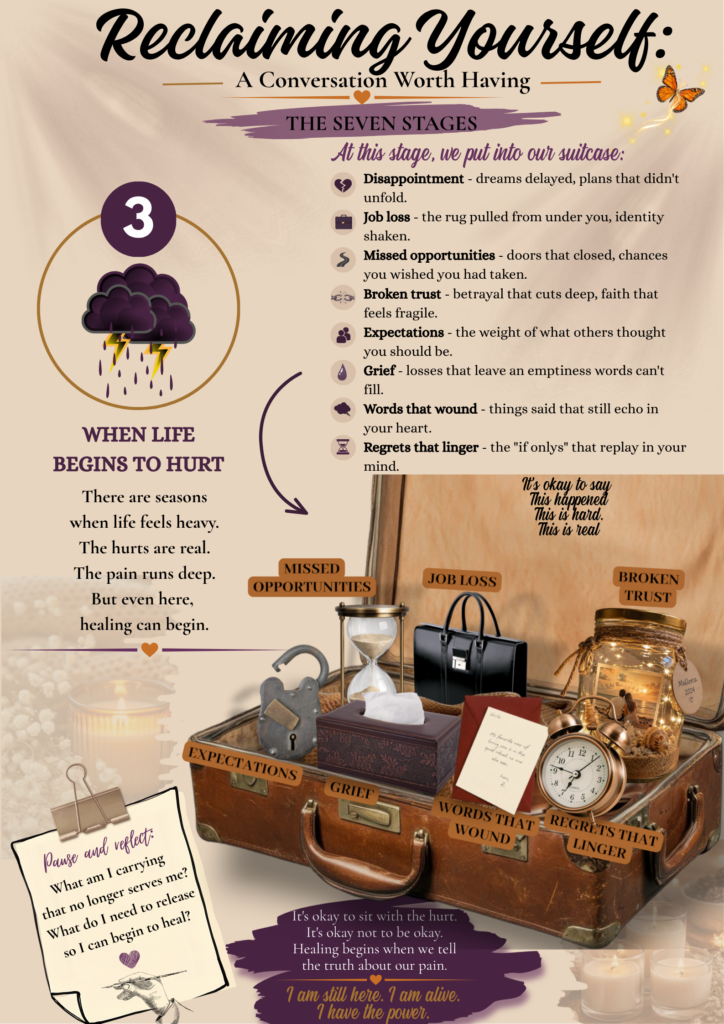
What went into the Suitcase?
Our suitcase is heavier now. Stage One gave us dreams, curiosity, adventure, and possibility. Stage Two brought relationships, work, responsibility, achievement and the many women we became.
Now other things have entered the suitcase: Disappointment, job loss, missed opportunities, broken trust, expectations, grief, words that wound, and regrets that linger.
Perhaps there is also anger, shame, questions, things left unsaid or things said that cannot be taken back. Maybe even a secret nobody knows you are carrying.
Some things were placed in the suitcase by other people. Some we put there ourselves. And some simply arrived because we lived. For now, do not unpack them. Do not decide what stays. Do not rush to forgive. Do not rush to release. Do not turn every wound into a lesson before you have acknowledged that it was a wound. There will be time for that.
Today, simply say: This happened. This mattered. This hurt. There is power in naming something truthfully. And Yet… There is something extraordinary about human beings. We can hurt and still function. We can be disappointed and still hope. We can have our hearts broken and still love. We can lose opportunities and create others. We can lose jobs and build new careers.
We can be wounded at work and find the courage to report it, confront it, leave it or begin again somewhere else. We can discover things we wish we had never known and somehow still get out of bed the next morning. Perhaps that is why people do not always know we are hurting. We become remarkably skilled at carrying pain while continuing with life.
But surviving something and processing it are not the same thing. Eventually, we have to stop pretending that because we survived it, it did not affect us.
Your Turn
This week’s questions are quieter. You do not have to answer them publicly. Some conversations belong in a journal. Some belong with a trusted friend. Some belong with a coach. Some workplace experiences may need to be documented and addressed through the appropriate professional channels. And some conversations need to begin privately, with yourself.
Ask yourself:
What disappointment have I minimized because I thought I should simply get over it?
Where have I been strong for so long that people stopped noticing I was carrying something heavy?
What did I expect from life that did not happen?
Is there a situation I have called “difficult” when, truthfully, it has become harmful?
Where do I need to speak up, seek support, set a boundary, report what is happening, or walk away?
What happened that changed how I saw myself, another person, work, family, love, or life itself?
And perhaps the hardest question:
What hurt have I never actually allowed myself to call hurt?
If you choose to join the public conversation, you do not have to tell us what happened.
Complete just one sentence:
“One thing life has taught me about hurt is………………………………………………………”
No names. No explanations required. No judgement. Because this stage is not about staying in pain. But neither is it about rushing past it. Sometimes before we can ask “What now?”, we first have to be courageous enough to say: “This is where it hurt.” And perhaps that is where something begins to shift. Not yet fixing. Not yet reclaiming. Not yet deciding what leaves the suitcase. Just recognizing what we have been carrying.
Because beneath the disappointment, the job loss, the missed opportunities, the broken trust, the expectations, the grief, the words that wounded, and the regrets that linger, there is still a woman who can say:
I am still here.
I am alive.
I have the power.
#ReclaimingYourself #AConversationWorthHaving #WhenLifeBeginsToHurt #IAmStillHere

Dr. Salome Gitoho has strategically built her practice around transition, reinvention, leadership coaching, mediation, and training; disciplines she identifies as the pillars of corporate and personal excellence.




Great article. Will read it slowly and take notes. But very relevant. Loss,most-often creeps in slowly.. but also important to hold onto hope and trust in God